Insights
Argentina vs Spain: what football reveals about Spanish and culture
Argentina vs Spain: what football reveals about Spanish and culture
2
min read

Argentina and Spain are about to face each other. For most people, that means a football match. For me, t is also a fascinating language and culture lesson.
Because Argentina and Spain share a language, but that does not mean we speak, think or express ourselves in exactly the same way.
And before we go any further, I want to make one thing clear: there is no “better” Spanish.
There is Spanish from Spain, Spanish from Argentina, Spanish from Mexico, Spanish from Colombia, Spanish from Chile, Spanish from Uruguay and many other varieties. They are all legitimate ways of speaking the same language.
Spanish is not a competition. Although, considering that Argentina and Spain are about to play each other, this is not the best moment to insist on that.
The language we share has a very long history
Spanish and Argentine Spanish come from the same linguistic family. Spanish developed from Latin and, over centuries, evolved differently across different regions.
Across Latin America, Spanish has developed through contact with Indigenous languages, migration, local cultures and different histories.
None of these varieties is a mistake. They are simply the result of people using language for a very long time and, naturally, changing it.
Check it out:
Spain | Argentina | English |
|---|---|---|
ordenador | computadora | computer |
móvil | celular | mobile phone |
coche | auto | car |
zumo | jugo | juice |
coger el autobús | tomar el colectivo | take the bus |
The important thing is not to ask which word is “correct”. The better question is: Where is this word used?
That is one of the reasons I teach Spanish across different varieties of the language. I want my students to understand that Spanish has different forms, and to learn the version—or versions—that best fit their goals.
And perhaps avoid confidently saying “quiero coger…” in Argentina unless you are absolutely certain you know what you are saying. The word is perfectly normal in Spain. In Argentina… well you know.
This is exactly why learning a language also means learning where, when and with whom certain words are used.
Football gives us a perfect language lesson
Football is one of the best places to observe how language works in real life. A textbook might teach you that a word has one translation. Real people will quickly demonstrate that this is an optimistic oversimplification.
Some differences are obvious. Others are much more subtle. A word can be grammatically correct in both countries but sound completely natural in one place and slightly unusual in another.
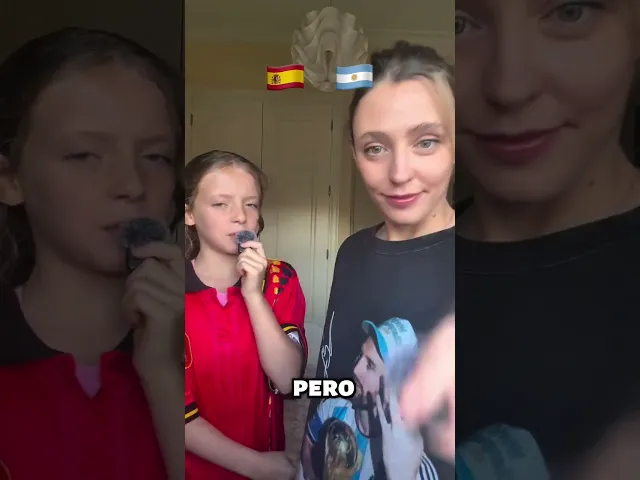
Video by juli.forcato
Even pronunciation has more than one story
One thing that often surprises Spanish learners is the pronunciation of words with 'll' and 'y' in Argentina.
In some parts of the country, particularly in certain regions, these sounds may be pronounced with a sound that is closer to the English sh but this is not how all Argentinians speak. Argentina is a large country with significant regional variation. In many parts of the country, the pronunciation is closer to a traditional y or ll sound.
This is important because learners often discover one version of Argentine Spanish and assume it represents the entire country. It doesn't.
The same happens with Spanish everywhere. A person from Valencia, Córdoba, Medellín or Lima may all speak Spanish naturally while sounding very different from one another.
The history behind the language is complicated
Argentina and Spain also share a complicated history.
Spanish colonisation profoundly shaped Argentina: its language, institutions, religion and many aspects of its culture, but history is never simply a story of one country giving another its language.
The Spanish spoken in Argentina developed through many influences, including Indigenous peoples, immigration from Europe and other parts of the world, and the cultural identity that developed locally over centuries.
For Argentinians, however, history has a way of making certain things feel slightly more complicated.
Again, yes, we are intense. We have history, identity and a tendency to attach a considerable amount of emotion to things that other people might consider relatively straightforward. A football match is a good example.
This is why I don't teach Spanish as a single correct system
My approach to Spanish coaching is based on real communication across the Spanish-speaking world.
Depending on your goals, you might be preparing to live in Argentina, travel through Latin America, communicate with people from different countries or understand a particular variety of Spanish more naturally.
That means learning the Spanish you actually need while also understanding that Spanish is not one single, uniform language.
A student might learn ordenador in Spain and later hear computadora in Argentina. They might learn vosotros and then hear ustedes.
They might hear a word pronounced differently or discover that a familiar expression has a completely different meaning somewhere else. That is not a problem, that is what happens when you learn a real language spoken by hundreds of millions of people.
And this is also why I understand the frustration of my students. I have been on both sides of the classroom. I know what it feels like to be the person who understands more than they can say. To know that you have studied something but still hesitate when you need to use it. To be the foreigner trying to follow a conversation and realise that knowing the grammar is not the same as being able to participate naturally.
That experience influences how I coach my students. I don't want them to simply memorise more Spanish, I want them to understand how the language works and build the confidence to use what they know.
Because when Argentina plays Spain, the language is the same but the chants, expressions, pronunciation, traditions, emotions and cultural references are not identical. And that's precisely what makes Spanish so interesting.
There is no better Spanish. There is only the Spanish people use to express their lives.
If you want to improve your Spanish through real communication, cultural context and personalised coaching, you can explore my Spanish coaching programs.
Argentina and Spain are about to face each other. For most people, that means a football match. For me, t is also a fascinating language and culture lesson.
Because Argentina and Spain share a language, but that does not mean we speak, think or express ourselves in exactly the same way.
And before we go any further, I want to make one thing clear: there is no “better” Spanish.
There is Spanish from Spain, Spanish from Argentina, Spanish from Mexico, Spanish from Colombia, Spanish from Chile, Spanish from Uruguay and many other varieties. They are all legitimate ways of speaking the same language.
Spanish is not a competition. Although, considering that Argentina and Spain are about to play each other, this is not the best moment to insist on that.
The language we share has a very long history
Spanish and Argentine Spanish come from the same linguistic family. Spanish developed from Latin and, over centuries, evolved differently across different regions.
Across Latin America, Spanish has developed through contact with Indigenous languages, migration, local cultures and different histories.
None of these varieties is a mistake. They are simply the result of people using language for a very long time and, naturally, changing it.
Check it out:
Spain | Argentina | English |
|---|---|---|
ordenador | computadora | computer |
móvil | celular | mobile phone |
coche | auto | car |
zumo | jugo | juice |
coger el autobús | tomar el colectivo | take the bus |
The important thing is not to ask which word is “correct”. The better question is: Where is this word used?
That is one of the reasons I teach Spanish across different varieties of the language. I want my students to understand that Spanish has different forms, and to learn the version—or versions—that best fit their goals.
And perhaps avoid confidently saying “quiero coger…” in Argentina unless you are absolutely certain you know what you are saying. The word is perfectly normal in Spain. In Argentina… well you know.
This is exactly why learning a language also means learning where, when and with whom certain words are used.
Football gives us a perfect language lesson
Football is one of the best places to observe how language works in real life. A textbook might teach you that a word has one translation. Real people will quickly demonstrate that this is an optimistic oversimplification.
Some differences are obvious. Others are much more subtle. A word can be grammatically correct in both countries but sound completely natural in one place and slightly unusual in another.
Video by juli.forcato
Even pronunciation has more than one story
One thing that often surprises Spanish learners is the pronunciation of words with 'll' and 'y' in Argentina.
In some parts of the country, particularly in certain regions, these sounds may be pronounced with a sound that is closer to the English sh but this is not how all Argentinians speak. Argentina is a large country with significant regional variation. In many parts of the country, the pronunciation is closer to a traditional y or ll sound.
This is important because learners often discover one version of Argentine Spanish and assume it represents the entire country. It doesn't.
The same happens with Spanish everywhere. A person from Valencia, Córdoba, Medellín or Lima may all speak Spanish naturally while sounding very different from one another.
The history behind the language is complicated
Argentina and Spain also share a complicated history.
Spanish colonisation profoundly shaped Argentina: its language, institutions, religion and many aspects of its culture, but history is never simply a story of one country giving another its language.
The Spanish spoken in Argentina developed through many influences, including Indigenous peoples, immigration from Europe and other parts of the world, and the cultural identity that developed locally over centuries.
For Argentinians, however, history has a way of making certain things feel slightly more complicated.
Again, yes, we are intense. We have history, identity and a tendency to attach a considerable amount of emotion to things that other people might consider relatively straightforward. A football match is a good example.
This is why I don't teach Spanish as a single correct system
My approach to Spanish coaching is based on real communication across the Spanish-speaking world.
Depending on your goals, you might be preparing to live in Argentina, travel through Latin America, communicate with people from different countries or understand a particular variety of Spanish more naturally.
That means learning the Spanish you actually need while also understanding that Spanish is not one single, uniform language.
A student might learn ordenador in Spain and later hear computadora in Argentina. They might learn vosotros and then hear ustedes.
They might hear a word pronounced differently or discover that a familiar expression has a completely different meaning somewhere else. That is not a problem, that is what happens when you learn a real language spoken by hundreds of millions of people.
And this is also why I understand the frustration of my students. I have been on both sides of the classroom. I know what it feels like to be the person who understands more than they can say. To know that you have studied something but still hesitate when you need to use it. To be the foreigner trying to follow a conversation and realise that knowing the grammar is not the same as being able to participate naturally.
That experience influences how I coach my students. I don't want them to simply memorise more Spanish, I want them to understand how the language works and build the confidence to use what they know.
Because when Argentina plays Spain, the language is the same but the chants, expressions, pronunciation, traditions, emotions and cultural references are not identical. And that's precisely what makes Spanish so interesting.
There is no better Spanish. There is only the Spanish people use to express their lives.
If you want to improve your Spanish through real communication, cultural context and personalised coaching, you can explore my Spanish coaching programs.

Written by Rocío Daniela Castro
Written by Rocío Daniela Castro

